Make products that put people first and expand access to their benefits.
Net Zero Emissions by 2030
At Google, our goal is to achieve net zero emissions across all of our operations and value chain by 2030.
Our Products
“Designers are problem solvers. And sustainability is the biggest problem for our generation to solve.”
– Ivy Ross, Head of Design for all Google hardware products
Ingredients matter.
A large part of manufacturing waste ends up in landfills. To reduce our carbon footprint and impact, we’re maximizing the use of recycled and renewable materials across our operations, products, and supply chains.
Pixel 9 contains recycled metals, glass, and plastic, and rare earth elements.2 The Pixel frame is 100% recycled aluminum.3 And the packaging is 100% plastic-free.4
Thoughtfully designed cases
Pixel 9, 9 Pro, and 9 Pro XL Cases are made with at least 42% recycled materials.5
Refined textiles
The Pixel Woven and Stretch Bands are made with recycled yarns.6
Reducing waste.
There is immense strain on our natural resources with an urgent need to balance consumption and consequences. So we’re trying to reduce the waste generated at all levels – from manufacturing to retail.
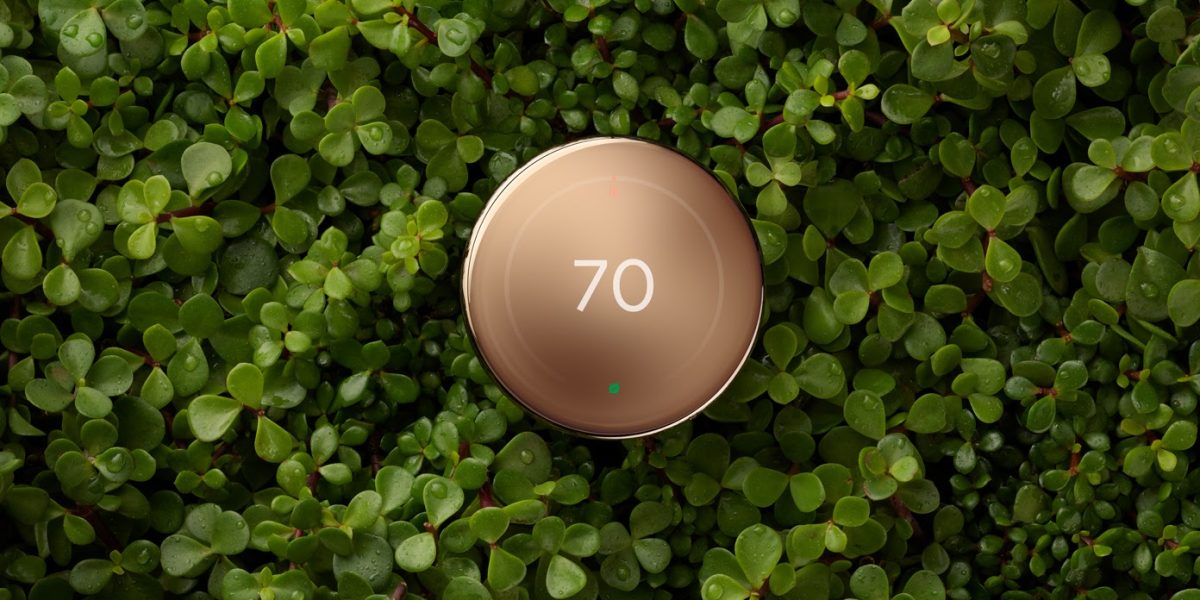
The Nest Thermostat is now made with 36% fewer parts for a less complicated design.
Versatility
Pixel Tablet features a flexible design, making them more versatile so they can continually adapt to people’s evolving preferences.
Our Supply Chains
"The most significant opportunity for improvement in environmental and human rights outcomes is in partnership with our suppliers."
- Anna Meegan
Investing in communities and resources.
We are working to take better care of the communities in which we operate. From partnering with mining companies to investing in biodiversity and renewable energy, we want to help build comprehensive approaches to our impact commitment.
Invest in a cleaner future.
At Google, our goal is to achieve net-zero emissions across all of our operations and value chain by 2030. We aim to reduce 50% of our combined Scope 1, 2 (market-based), and 3 absolute emissions (compared to our 2019 base year) by 2030, and plan to invest in nature-based and technology-based carbon removal solutions to neutralize our remaining emissions.
From 2010 to 2023, we entered into agreements to invest more than $3.1 billion in renewable energy projects with an expected combined generation capacity of approximately 4.5 GW.19
Investment commitments
We've committed to investing roughly $150 million USD into renewable energy projects in key manufacturing regions, aiming to catalyse roughly $1.5 billion USD of capital into renewable energy.
Committed to sourcing our minerals responsibly.
We’re working on making the mineral-tracking process more transparent for everyone.
In 2018, we joined Cisco, SGS, Volkswagen, and Peruvian mining company Minsur to launch a plan for end-to-end mineral traceability.
Phase one
The pilot focuses on tin from Minsur’s San Rafael mine, which produces approximately 6% of the world’s tin supply.
Conflict-free minerals
As part of Google’s conflict minerals program in Congo and neighboring countries, we partner with governmental organizations, industry groups, and NGOs to aid conflict-free gold sourcing.
The People
“When we build products at Google, we think in terms of building for everyone, with everyone. This is hard work...it’s a journey, and we’re committed to learning and improving.”
- Annie Jean-Baptiste, Head of Product Inclusion at Google, Building for Everyone
Building for the users
Supporting a clean energy future.
Nest Renew is a new service for compatible Nest thermostats10 that makes it easy to support clean energy, right from home.10
Electricity from the grid is often a mix of non-renewable energy from gas and coal, and clean energy from solar and wind farms. Nest Renew can estimate when energy in a region is cleaner and works with Nest thermostats to help users in the US automatically shift usage11 to times when the grid is cleaner,12 or less expensive.13
With a Nest thermostat, people can also track how much energy they use every day and see how they can use less.15
Since 2011, Nest thermostats have saved an estimated
183,737,757,297
kWh of energy16
Stay in the know.
Get news, offers, cart reminders, personalized emails, and surveys from the Google Store.